

What is a shamanic journey? On the surface, it can sound a little strange. Someone tells you to lie down, close your eyes, listen to a repetitive drumbeat — and then suddenly people are describing traveling to another world, meeting a spirit animal, talking to a relative who died twenty years ago, or receiving information they didn’t consciously know. The immediate questions almost always come: What’s actually happening here? Am I imagining this? Is it my subconscious? Am I really communicating with spirit?
I want to walk you through all of that today. What shamanic journey actually is, why the drum matters, what it can be used for, and — maybe most importantly — how to relate to the “am I just making this up?” question so that it stops blocking your experience.
Because here’s what I’ve learned after two decades of this practice: shamanic journeying is one of the fastest, most reliable ways to reconnect to your own depth. To spirit. To your intuition. To the wonder that so easily gets buried under the ordinary weight of daily life. It’s one of my oldest practices, one of my most-used practices, and one of the ones I return to whenever I feel like I’ve drifted out of flow.
What a Shamanic Journeying Actually Is
At its simplest, a shamanic journey is a practice of intentionally shifting your awareness in order to have an experience outside of your ordinary, waking, rational state of consciousness.
Different traditions describe what’s happening in different ways. Within a spiritual framework — which is the one I usually work from — you’re getting yourself into a light trance state, traveling into a non-ordinary realm outside of this 3D world, and communicating with spirits or other forms of consciousness. Within a scientific framework, you’re using rhythmic auditory stimulation to shift your brain into theta wave activity, opening access to intuitive, non-linear ways of knowing. Both explanations point at the same thing. They’re just different languages for describing the same shift.
I want to say something clearly at the start: shamanic journey is not the same as “shamanic sound healing.” A lot of what’s being marketed under the shamanic umbrella right now — people using buffalo drums in sound bath settings, ambient shamanic-flavored music — isn’t actually shamanic journey. Journey is a specific practice with a specific structure. You begin with an intention, you enter into a trance state, you follow a very specific protocol to access non-ordinary realms, and you engage with what shows up. Someone drumming near you does not automatically make it a journey. The technology is in the structure of your consciousness, not just in the sound.
How the Practice Works
Every journey starts with an intention. What do you want? What are you asking for? Maybe you want healing. Maybe you have a question. Maybe you want to meet a helping spirit. Maybe you want a new perspective on something. Maybe you just want to explore.
Then you lie down, get comfortable, close your eyes, and either listen to a repetitive drumbeat or drum for yourself. You visualize a specific kind of entrance to access the non-ordinary realms. And once you’re in — you see what happens.
I often describe journeying as being like the video game Zelda. You have an intention. You start following the signs. Maybe a spirit being shows up and you have a conversation. That leads you somewhere else. Maybe you’re given a gift. Maybe you’re shown a memory. You wander, you follow, you receive.
Not everyone experiences journey the same way. A lot of people expect it to look like a movie playing behind their eyelids. It rarely does. For most people — I’d say over ninety percent — you’re not seeing crisp visual images. You’re sensing. You’re perceiving through the mind’s eye. Some people mostly feel what’s happening. Others hear it. Others get flashes of imagery. There’s no wrong way to receive.
Why the Drum Matters
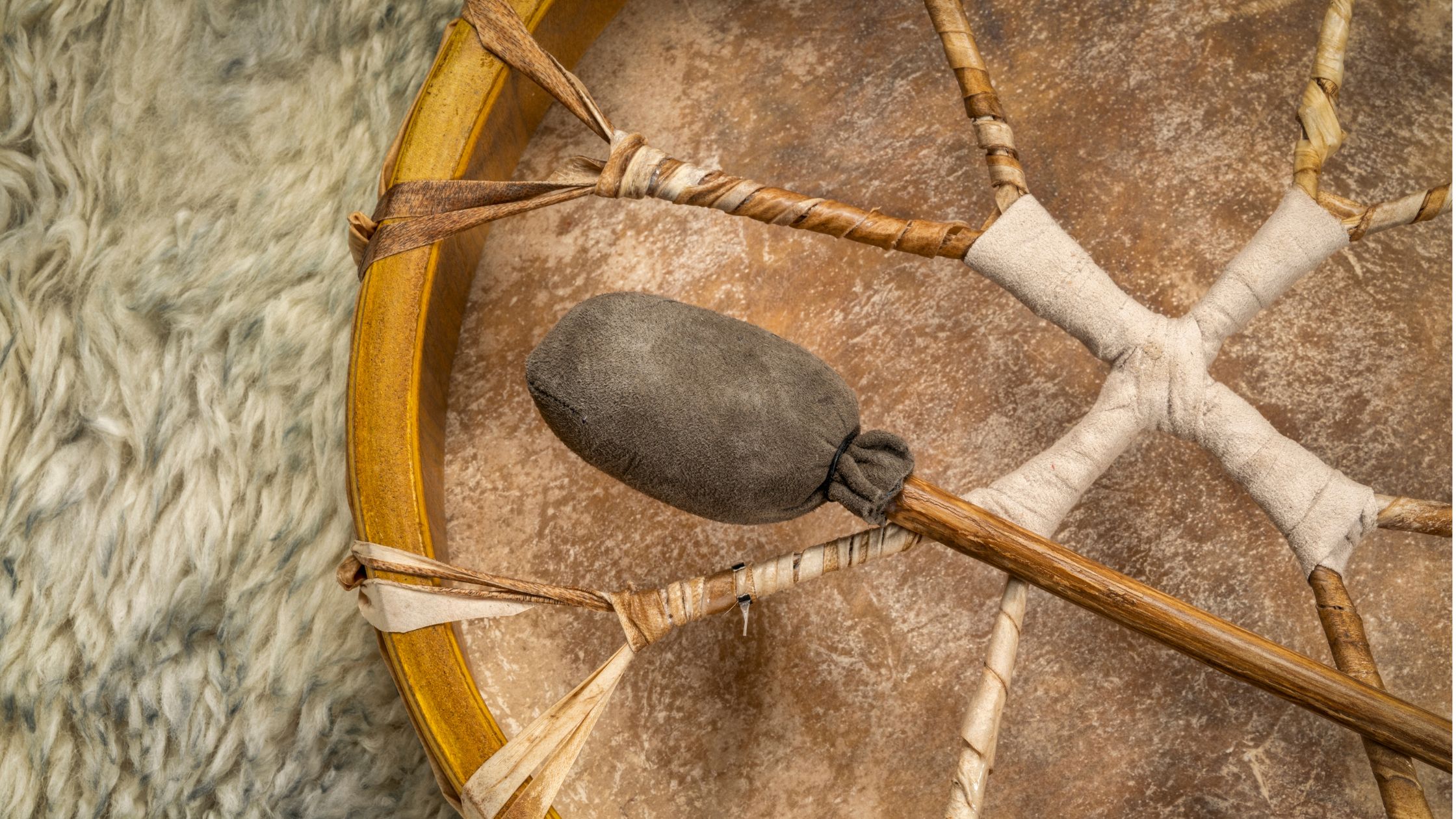
The drum isn’t decorative. It’s part of the technology of the practice.
In shamanic tradition, the drum is understood as the heartbeat of the earth. When you follow that steady beat, you’re syncing your awareness to the rhythm of the earth itself. The earth, in this framework, is dreaming its own dream through you — and when you’re tuned to that rhythm, you’re tuned to the version of your life that’s most in alignment with your highest self.
In neuroscience terms, that steady rhythmic drumming shifts your brain into theta waves. It’s the same brainwave state you’re in during deep meditation, right before sleep, or in creative flow. It’s a light trance state — you’re still aware you’re lying in a room, you can still hear the drum, you’re not asleep — but the thinking mind loosens its grip enough that information you couldn’t reach through ordinary thought becomes available.
Both explanations are true. The drum is spiritual technology and it’s neuroscience. What matters is that it works.
My First Shamanic Journey (And Something My Mother Told Me Afterward)
I want to share one of my earliest shamanic journey examples, because it shaped how I understand this practice.
I was about twenty years old, at a workshop, and I didn’t even really know what shamanism was at the time. The person I was partnered with also had zero experience. He wasn’t someone who identified as psychic or particularly intuitive — we were both there simply because we liked exploring different ways of understanding consciousness.
The practice was a power animal retrieval. A power animal, as I understand it, is an animal spirit assigned to you at birth — or one you make an agreement with before you’re born — whose role is to help you learn to step into your power. It’s not necessarily the animal that reflects your personality. It’s the one that will help you understand your gifts.
He journeyed for me. When he came back, he described what happened: as soon as he asked to see my power animal, hundreds of animals came at him fast, one after another. Eventually he followed the protocol and brought back an owl. He started telling me qualities that stood out about the owl — and remember, this was someone who had barely spoken to me before that day.
A few of the things he described landed hard. Owls are known for exceptional timing and precision. And I’d always had this experience of reaching out to people at exactly the right moment — sometimes even sending someone a silent blessing at the same second they were making a wish. My energy carries a natural rhythm that syncs with larger cycles of time and season. All of these were things I’d noticed about myself but never known how to name or value.
I could have sat with it as a beautiful coincidence. But here’s what happened afterward. I called my mom to tell her about the weekend. When I got to the part about the owl, she said, “You know our last name is Polish and it means owl in Polish.”
I did not know that.
That was one of my earliest experiences of how precise this practice can be. It also planted the exact question that most people wrestle with: did that person just imagine it, or did something real happen? We’ll get to that.
Shamanic Journey Examples: What This Practice Is Actually For
People use shamanic journeying for many different things. Some real shamanic journey examples from my own life and the lives of people I’ve worked with:
Healing. This is what most people come for. Not just emotional or spiritual healing in the abstract, but healing at a level the thinking mind alone can’t reach.
I once worked with a client who was struggling with a deep loneliness that didn’t match her outer life. She had friends. She had people around her. But she felt like she didn’t quite belong to anyone. She came into one of my journeys and set an intention around healing that loneliness — nothing more specific than that.
During the journey, her grandmother — who had passed when she was very young — appeared and held her almost like she was a child again. She didn’t just think about her grandmother holding her. She felt it in her body. She saw it in her mind’s eye. She felt the shift happen inside her. Afterward, the loneliness had lifted. Not intellectually. Not as an idea. It was actually gone.
She still had to do the outer work of building community afterward. But the black pit of loneliness itself had shifted from one experience.
Guidance. When you’re stuck on a decision that no amount of thinking can resolve, journey opens access to a different kind of knowing. You come out with clarity that would’ve taken months to reach through analysis alone.
Meeting helping spirits. Power animals, guides, ancestors, teachers — journey gives you a direct way to build relationships with the spirits that walk with you.
Exploration for its own sake. This is one of the most overlooked reasons to journey. You don’t have to be broken or in crisis to do this practice. Curiosity is a valid reason. One of my favorite journeys started with no goal at all — I was in one of the lower realms, and spirit showed me a kind of portal that took me somewhere new. The realm I ended up in looked like the ocean meeting the night sky. A spirit being there explained to me that before you’re born, you meet with them to pick your life path — what you’re here to learn, the people you’ll interact with, the lessons you’ll agree to receive. Then you jump into that access point, and boom — you’re in the womb.
It was fascinating. My body recognized it. It landed with a “yes, I remember that.” At the time, I didn’t have the language of soul contracts — none of that had been part of my education or reading. Afterward, I discovered whole traditions and books written on this exact experience. And later, I saw the visual of that place — the ocean meeting the night sky — depicted in the TV show The OA. Not just the concept, but the actual imagery.
That’s what journeying can give you. Access to a collective knowing that lives underneath our current cultural conversation.
The Difference Between Journey and Meditation
Most meditation practices ask you to notice your thoughts without attaching to them. If a thought comes up — what should I make for dinner? — you notice it and let it pass.
Journey is different. In journey, you do let your thoughts guide you — but not the ordinary logistical thoughts. You’re following the intelligent thoughts. If you’re on a journey and a wolf shows up in your mind, that’s not random. That’s the wolf spirit coming to speak with you. Instead of dismissing the thought, you engage with the wolf. You let that thread take you where it wants to take you.
The drum guides the whole thing. It keeps your ordinary mind loose enough for the deeper intelligence to come through.
Here’s something interesting: most people have already done a version of shamanic journeying naturally. They just don’t have language for it. When I first learned this practice, I realized I had been doing it as a kid during meditation. I’d stop trying to follow a formal protocol and just let my mind wander through images and beings and landscapes, following the thread of it. I didn’t know what I was doing. But once I had the actual structure, everything I’d been doing informally clicked into a practice I could return to on purpose.
If you find yourself thinking, “wait, I think I already do this,” — you probably do. Journey just gives you the structure to make it repeatable and intentional.
The “Am I Just Making This Up?” Question
Almost everyone new to journeying gets stuck here. Is this real, or did I imagine it?
I want to give you my honest answer: it’s a little bit of both. I do experience spirits as literal, external beings that interact with us. And I also experience journey as a way our consciousness works — a capacity of our awareness that we’ve largely forgotten how to use. Both are true. It’s not either-or.
But here’s what I want you to really anchor in: if you keep getting stuck on the “did I make this up?” question, you’re actually stepping away from the magic of what’s happening. You’re blocking yourself from receiving the experience spirit is trying to give you.
In the client story I shared, it wouldn’t have mattered if she’d made the whole thing up. She felt it in her body. The loneliness lifted. The experience was the medicine. Whether you can prove the grandmother was “really there” or whether her nervous system found something it needed within itself — either way, she was changed by it.
If you approach journey with the constant meta-question of is this real? running in the background, you never actually get to be in it. You’re keeping one foot in analysis. And spirit can’t fully meet you there.
The practice, over time, develops its own discernment. You’ll start to feel the difference between when your thinking mind is inserting something and when an experience is genuinely happening to you. You’ll also, more often than not, receive information you couldn’t have known through ordinary means — the way my mother’s confirmation about the owl arrived after the fact. When that keeps happening, the question tends to fall away on its own.
For now: if you’re hung up on it, let it go. And if it really matters to you, the answer is to do more journey, not less. You’ll find your truth through experience, not through analysis.
When Journey Becomes About Wonder, Not Fixing
There are seasons in life when everything starts to feel monotonous. Even for me — and I have a practice rich with sacredness, and I’m connected to spirit most of the time — I still hit stretches where daily life feels like nothing but work, errands, messages, dinner, sleep, repeat. That’s part of being a human on earth. You have to be able to sit with the mundane too.
But when I notice I’ve been in that flat place for a few weeks, journey is one of the fastest ways I know to come back to wonder. It gets me out of ordinary consciousness and directly reconnected to spirit almost immediately. I get curious again. What will I see? What if I ask this question? What happens if I follow that animal?
My healing journey used to be about fixing things. Now it’s often about play. Exploration for the sake of exploration. Learning how consciousness works. And journey has been one of the practices that has taught me — at a body level, not just intellectually — to hold multiple worlds at once. To be practical and healing and mystical and aware I’m lying on the floor of my house and aware I’m somewhere else entirely, all at the same time. The more you journey, the more that layered awareness becomes just how you live.
A Few Things I Want You to Hold If You’re New to This
If you’re considering trying shamanic journey — or you’ve done it once or twice and aren’t sure you did it “right” — here’s what I want you to hear.
First, you don’t need fantastical visions to have a life-changing experience. One of the biggest ways people block themselves is by expecting fireworks. They think that if they don’t see a full-color spirit vision, nothing happened. Some of the most transformative journeys look quiet from the outside. Notice what you see, feel, sense — even if it’s small. That’s the doorway.
Second, don’t analyze while you’re inside the journey. Wait until you come back. Analysis mid-journey collapses the state. Let the experience unfold. You can look at it afterward.
Third, be careful of the belief that it needs to be big to be real. That’s the same trap people fall into with energy work, psychedelics, and any other practice that opens non-ordinary states. Subtle doesn’t mean nothing happened. Subtle often means something is landing at a level your thinking mind isn’t equipped to see yet.
Fourth, let your body be part of it. Journey isn’t just a head thing. Your body carries memory, wisdom, and awareness of how the non-ordinary realms work. When you let your body participate — with movement beforehand, with breath during, with sensation throughout — the whole practice deepens.
What is a shamanic journey, in the end? It’s a reminder that you are so much more than the ordinary you. It’s a way of remembering the awareness, the languages, the gifts that live inside you already. It’s a doorway back to the sense of wonder and magic that everyday life so easily dulls. Follow the drum. Follow the heartbeat. See what happens.
That’s the practice. That’s the magic.
Ready to Bring This Into Your Practice?
If you already work with clients and journeying keeps calling you deeper, The Way of the Hollow Bone Master Healer Certification is where that call becomes your craft. Over nine months, you’ll learn to journey for others with clarity and confidence, hold space for whatever shows up, and practice as yourself rather than an echo of your teachers. Apply now to see if it’s the right fit for your path.
Listen to the full episode: What Is a Shamanic Journey? Real Experiences With Spirit, Healing & Other Realms